Tuesday, June 11, 2013

HOW CAN AN AMERICAN FUGITIVE ESCAPE THE AMERICAN LEGAL SYSTEM?

Let's say you are an American facing prosecution and you want to escape the long arm of the American law. Where's the best place to go? Iceland, perhaps, and we'll get to that in a moment. Edward Snowden, who faces potential prosecution after declaring that he leaked details of a highly classified U.S. intelligence program, caught a flight to Hong Kong.
Snowden, who hasn't been charged with an offense at this point, says he chose the city for its tradition of free speech. Yet Hong Kong has an extradition treaty with the U.S., and legal experts say that would make him vulnerable if the U.S. government seeks to prosecute him.
So what are the options for a fugitive from the U.S. legal system?
Think Iceland First: This country has a reputation of shielding those wanted in high-profile cases. American Bobby Fischer won the most widely publicized chess match in history when he defeated Boris Spassky of the Soviet Union and became the world chess champion in Reykjavik, Iceland, in 1972.
The reclusive Fischer re-emerged in 1992 for a rematch with Spassky, which was played in Yugoslavia. Because the Balkan nation was under international sanctions, the U.S. issued a warrant for Fischer's arrest. To avoid prosecution, he remained abroad and out of sight aside from occasional bursts of anti-American invective.
However, he was arrested in Japan in 2004. Seeking to avoid deportation to the U.S., he reached out to Iceland, which welcomed him in 2005. He remained there until his 2008 death. The Guardian has quoted Snowden as saying he would like to seek asylum in Iceland, though Iceland's Interior Ministry said he has not made an application.
Claim Political Asylum: The example here is Julian Assange, the Australian citizen of WikiLeaks fame. He's been holed up for nearly a year at Ecuador's embassy in London and has been granted diplomatic asylum. But he hasn't dared to leave the embassy because Britain says it intends to extradite him to Sweden for questioning over allegations of sexual assault.
"If you have a country that wants to make a political point, this might seem like an attractive option," says Robert Anello, a New York lawyer who has handled multiple extradition cases. "But you have to think ahead. Today, this country may think it's in their interests. But how long is this going to be in their interests? Politicians and policies change."
WikiLeaks, by the way, has an Iceland connection. Donations to the group have been processed there. Despite pressure by the U.S. to cut off funding for the group, an Icelandic court gave WikiLeaks a victory in April, ruling that a financial firm in Iceland would have to continue handling transactions.
Find A Country Antagonistic To America: In one long-running case, fugitive financier Robert Vesco fled the U.S. in 1973 after he was indicted on charges of business fraud. He then bounced around several Latin American countries and Caribbean islands. He made a large financial donation in Costa Rica, where a law was subsequently passed guaranteeing that he would not be extradited. Vesco later moved on to Nicaragua, where the leftist Sandinista government allowed him in.
He eventually settled in Fidel Castro's Cuba in 1982 in his quest to avoid extradition. But he was later jailed in Cuba on drug smuggling charges and reportedly died there in 2007 of lung cancer. Vesco's case is also seen as an example of great wealth buying protection abroad, at least for a while. In some cases, fugitives have even been able to acquire citizenship and live out their years in comfort. But it can take deep pockets to maintain that protection."If your fortune runs out, you may find that you are no longer welcome," says Anello - From National Public Radio (NPR).

Monday, June 10, 2013

WHO IS A TRUE DISCIPLE OF JESUS CHRIST IN ALL REALITY?

Discipleship denotes or depicts many different meanings to the Church folks in the world of Christianity today in our 21st century human universe. Who is a disciple of Jesus Christ in all truth, honesty and reality? How do you become the disciple of Jesus Christ? What are the visible real life traits that the world must see in a person to show that he or she is a true disciple of Jesus Christ in this life? What is the earthly prize that is attached to a life of discipleship of Jesus Christ? Are you a true disciple of Jesus Christ or a disciple and a follower of the men of God and their Church dogmas? Do you personally put the words and the teachings of your own pastors or local Churches above the  sound doctrine of the Bible and the words or teachings of Jesus Christ in all reality?

The term "disciple" was used frequently by Jesus Christ in his earthly ministry. In the Koine Greek, the original language of the New Testament Scriptures, the word "Disciple" is the word "Mathetes". This word "Mathetes" literarily means a learner, a student, a pupil or a follower of another person. A true disciple of Jesus Christ has the following attributes in real life and in his or her Christian way of life:(i). A disciple of Jesus Christ is totally submissive to the authority, philosophy, words and the teachings (doctrine) of his master only (Jesus Christ). (ii). A true disciple of Jesus Christ  is a public or open defender of his master's doctrine (the words and the teachings of Jesus Christ). (iii). A true disciple of Jesus Christ is a true practical doer of his master's doctrine (the words and the teachings of Jesus Christ) in all reality. (iv). A true disciple of Jesus Christ is 100% ready and fully prepared to face any public oppositions or persecutions that are mounted against him or her or the doctrine of his or her master (Jesus Christ) by others, including the highest ultimate prize of physical death or martyrdom.

Sunday, June 9, 2013

DID THE WRIGHT BROTHERS BUILD THE FIRST POWERED AIRCRAFT IN THE WORLD?

Some things you just know for a fact. First U.S. president: George Washington. First human to walk on the moon: Neil Armstrong. First to achieve powered flight: Orville and Wilbur Wright.
Wrong. At least that's what Connecticut says.
State lawmakers passed a bill this week to honor Gustave Whitehead, who they claim beat the Wrights by two years.
Gustave who? Whitehead.
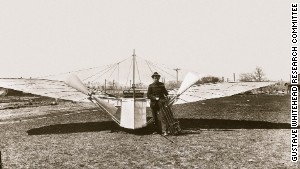
According to a 1901 Connecticut newspaper account, Whitehead -- a German immigrant -- flew his aircraft 150 feet in the air for about a half mile over the city of Bridgeport. The claim has been backed up by a respected aviation reference guide.
The debate has got the Smithsonian's longtime aviation historian frustrated and worried. It also has triggered conspiratorial accusations about a "secret agreement" between the revered museum and the Wright brothers.
A magnified image may show Whitehead\'s \
A magnified image may show Whitehead's "monoplane in flight with a central mast" and a tree on the right, says John Brown. Brown says it could be a photo that reporters described in news reports of the day.
Let's pause to remember that, hey, these guys are worldwide heroes. The image of their two-winged plane has appeared on U.S. money. On postage stamps, too. Kitty Hawk, North Carolina, where the Wrights flew, stands as a popular national landmark. It generates untold tourism dollars for a state that has labeled its car license tags with the words, "First in Flight."
These are more than just bragging rights. A lot is at stake. This is a big deal.
"There is no legitimacy to the claim," says Tom Crouch, the Smithsonian's aviation historian."Justice is at risk. Credit should go where credit is deserved."
Not long after Whitehead's alleged flight, Crouch says, experts tried to find witnesses quoted in the Connecticut newspaper's account. Only one of two named witnesses could be found, says Crouch, and that witness said the flight never happened.
If Whitehead really was first to fly, Crouch asks, "why didn't he repeat it later? Did he forget the secret of flight? Then he started building machines based on other people's designs. Why would he do that if his own inventions were successful?"
Ever since Whitehead's flight, Crouch says "absolutely everyone has rejected those claims. No one accepted them." Until now.
"Jane's All the World's Aircraft," a respected aviation reference guide, has endorsed the claim.
Also, Australian aviation historian John Brown says he found key photographic evidence. Last March, while rummaging through a museum attic in Germany, Brown says he found a lost photo that may depict the plane in flight.
"It was quite an emotional moment for me. I just jumped up in the air screaming," Brown says when experts confirmed that the photo was authentic.
But does the photo show the plane in flight?
"It's just a blotch," says Crouch, describing the blurry image. "It's not an airplane."
Brown agrees that the blurry image fails to offer definitive proof. But rather than trying to prove what the photograph shows or doesn't show, Brown has been focusing on establishing the credibility of journalists and witness reports from the 1901 flight. Journalists in the 1930s and afterward interviewed 17 witnesses who said they saw Whitehead flying, Brown says. The stories by 14 of those witnesses were notarized. Based on his research, Brown believes Whitehead did indeed fly before the Wrights.
Then there's that so-called "secret agreement."
"In fact," Crouch says, "it was never secret."
"That's not true," Brown said later. "It wasn't subject to the official secrets act, but it was kept from the public."
To hear Crouch tell it, when the Wright family signed a contract to give the Smithsonian the brothers' plane, the museum promised never to declare another aircraft the first to achieve powered flight.
In this undated photo, Gustave Whitehead stands with his aircraft.
Crouch says the family "stuck one clause into that contract that said if the Smithsonian ever says anybody flew before the Wright brothers, we have the right to take the airplane back. That clause is in fact still in the contract," Crouch says. "As an honest historian, I never felt bound by that clause. If I found evidence that I think indicated somebody else had flown before the Wrights, I would say so."
"What else would you say in his shoes?" asks Brown. "And if that's the case, why doesn't he examine the Whitehead claim?"
Brown says he recently worked with the Smithsonian on a project for the Smithsonian Channel.
For Connecticut state Rep. Charles Clemons Jr., one of the sponsors of the bill, acknowledging Whitehead's flight means money and prestige for his hometown.
"It will put Bridgeport on the map." Clemons says, "it will become synonymous with being first in flight, which would enable us to have a museum. With that, we would generate some tourist attractions." With the economy being what it is these days, Clemons says the tourism dollars would be important to the region.
Clemons mentions that Bridgeport is already known as the home of another flying object -- the Frisbee. But that claim also has been the subject of some debate.
Does Clemons actually believe Whitehead was first? "Yeah," he says confidently. He thinks history books should be re-written to say Whitehead beat the Wrights.
No matter, says Crouch. The truth will win out. "You can't legislate history," he says.
Brown says, "it's the Smithsonian that tried to negotiate history with this contract with the Wrights."
Meanwhile, the move puts Connecticut at odds with North Carolina and Ohio -- who've been fighting amongst themselves for decades for a share of the Wright brothers' tourism dollars.
I just jumped up in the air screaming.
John Brown, aviation historian
Most everybody knows about the brothers' aviation experiments on the North Carolina dunes. But Ohio reminds the world that the Wrights lived in Dayton. There, in their bicycle shop, they invented and developed much of their aviation machinery. There's a reason why the University of Dayton's teams are called The Flyers.
But what about Jane's? Their reference guide endorsement has to mean something, right? As respected as Jane's is, says Crouch, "it's not a historical publication. It's a reference book. It's damaging and that's why it kind of worries me."
The Whitehead story, which pops up in the media every few decades, is dangerous, Crouch says, because it plants the seeds of doubt in a story which should be seen as indisputable.
However, this isn't the only dispute against the Wright brothers' legacy. Crouch says millions of Brazilians believe their pioneer aviator Alberto Santos-Dumont actually invented the airplane. "Brazil claims Santos-Dumont was first because his aircraft had wheels, and the Wright's launched on rails," Crouch says.
Whatever the case, Connecticut has started a brawl that could end up rewriting world history. Or it could all fade away in a blur of unproven claims - From CNN.

"THE LEAKER OF THE AMERICA'S GOVERNMENT SECRET INTELLIGENCE PROGRAM SPEAKS OUT"

A 29-year-old computer technician for a U.S. defense contractor provided the British newspaper the Guardian with details of a top-secret American program that sifts through reams of data from telecommunications companies, the newspaper revealed Sunday.
"My sole motive is to inform the public as to that which is done in their name and that which is done against them," the source, Edward Snowden, told the Guardian.
Snowden is a former technical assistant for the CIA and has been working at the National Security Agency, the U.S. electronic intelligence agency, for the past four years, the newspaper reported. He said he gave up a six-figure job in Hawaii and moved to Hong Kong in preparation for the expected fallout from his disclosures.
"I'm willing to sacrifice all of that because I can't in good conscience allow the U.S. government to destroy privacy, internet freedom and basic liberties for people around the world with this massive surveillance machine they're secretly building," he said. From CNN.

Saturday, June 8, 2013

"THE RADICAL FORM OF ISLAM THREATENS THE WESTERN CIVILIZATION WORLDWIDE"

The many centuries old western civilization that was built on the free market enterprise (capitalism), representative democracy and human constitutional freedom or liberty has been actively fighting against a radical form of Islam since the sudden and the final collapse of the global communism in 1990 when the then Union of Soviet Socialist RepublIc (USSR) collapsed suddenly after over seventy years of cold war against the western civilization. The West-East conflict divided the whole humanity for those 70 years plus of its existence at that time into the two distinct and different political camps as well as ideologies (the west and the east).

What is the origin of this type of radical Islamic terrorism that eluded the world in the 20th century? Does this radical Islamic terrorism have any connection to the collapse of the communism in the Soviet Union in 1990? Does this radical form of Islam originated from the unresolved 65 years old political conflict between Israel and the State of Palestine? What is directly responsible for the rapid growth of this type of radical Islam around the world today from the traditional Islamic countries to the nations of the western world? Are the various methods that are presently employed by the various western nations against this form of radical Islam truly working effectively in all honesty and reality? How will the entire western civilization that is built on human liberty and privacy be affected at the end of the day in this ongoing global war against this form of radical Islamic terrorism that threatens many of the 21st century nations around the world? Only time will tell.


Thursday, June 6, 2013

"AMERICA'S SECURITY AGENCIES MINE CUSTOMERS' DATA FROM NINE INTERNET COMPANIES"

The National Security Agency and the FBI are tapping directly into the central servers of nine leading U.S. Internet companies, extracting audio and video chats, photographs, e-mails, documents, and connection logs that enable analysts to track foreign targets, according to a top-secret document obtained by The Washington Post. The program, code-named PRISM, has not been made public until now. It may be the first of its kind. The NSA prides itself on stealing secrets and breaking codes, and it is accustomed to corporate partnerships that help it divert data traffic or sidestep barriers. But there has never been a Google or Facebook before, and it is unlikely that there are richer troves of valuable intelligence than the ones in Silicon Valley.

Equally unusual is the way the NSA extracts what it wants, according to the document: “Collection directly from the servers of these U.S. Service Providers: Microsoft, Yahoo, Google, Facebook, PalTalk, AOL, Skype, YouTube, Apple.” PRISM was launched from the ashes of President George W. Bush’s secret program of warrantless domestic surveillance in 2007, after news media disclosures, lawsuits and the Foreign Intelligence Surveillance Court forced the president to look for new authority. Congress obliged with the Protect America Act in 2007 and the FISA Amendments Act of 2008, which immunized private companies that cooperated voluntarily with U.S. intelligence collection. PRISM recruited its first partner, Microsoft, and began six years of rapidly growing data collection beneath the surface of a roiling national debate on surveillance and privacy. Late last year, when critics in Congress sought changes in the FISA Amendments Act, the only lawmakers who knew about PRISM were bound by oaths of office to hold their tongues.

The court-approved program is focused on foreign communications traffic, which often flows through U.S. servers even when sent from one overseas location to another. Between 2004 and 2007, Bush administration lawyers persuaded federal FISA judges to issue surveillance orders in a fundamentally new form. Until then the government had to show probable cause that a particular “target” and “facility” were both connected to terrorism or espionage. In four new orders, which remain classified, the court defined massive data sets as “facilities” and agreed to certify periodically that the government had reasonable procedures in place to minimize collection of “U.S. persons” data without a warrant. In a statement issue late Thursday, Director of National Intelligence James R. Clapper said “information collected under this program is among the most important and valuable foreign intelligence information we collect, and is used to protect our nation from a wide variety of threats. The unauthorized disclosure of information about this important and entirely legal program is reprehensible and risks important protections for the security of Americans.” Clapper added that there were numerous inaccuracies in reports about PRISM by The Post and the Guardian newspaper, but he did not specify any.

Jameel Jaffer, deputy legal director of the American Civil Liberties Union, said: “I would just push back on the idea that the court has signed off on it, so why worry? This is a court that meets in secret, allows only the government to appear before it, and publishes almost none of its opinions. It has never been an effective check on government.” Several companies contacted by The Post said they had no knowledge of the program, did not allow direct government access to their servers and asserted that they responded only to targeted requests for information. “We do not provide any government organization with direct access to Facebook servers,” said Joe Sullivan, chief security officer for Facebook. “When Facebook is asked for data or information about specific individuals, we carefully scrutinize any such request for compliance with all applicable laws, and provide information only to the extent required by law.” “We have never heard of PRISM,” said Steve Dowling, a spokesman for Apple. “We do not provide any government agency with direct access to our servers, and any government agency requesting customer data must get a court order.”

It is possible that the conflict between the PRISM slides and the company spokesmen is the result of imprecision on the part of the NSA author. In another classified report obtained by The Post, the arrangement is described as allowing “collection managers [to send] content tasking instructions directly to equipment installed at company-controlled locations,” rather than directly to company servers. Government officials and the document itself made clear that the NSA regarded the identities of its private partners as PRISM’s most sensitive secret, fearing that the companies would withdraw from the program if exposed. “98 percent of PRISM production is based on Yahoo, Google and Microsoft; we need to make sure we don’t harm these sources,” the briefing’s author wrote in his speaker’s notes.

An internal presentation of 41 briefing slides on PRISM, dated April 2013 and intended for senior analysts in the NSA’s Signals Intelligence Directorate, described the new tool as the most prolific contributor to the President’s Daily Brief, which cited PRISM data in 1,477 items last year. According to the slides and other supporting materials obtained by The Post, “NSA reporting increasingly relies on PRISM” as its leading source of raw material, accounting for nearly 1 in 7 intelligence reports. That is a remarkable figure in an agency that measures annual intake in the trillions of communications. It is all the more striking because the NSA, whose lawful mission is foreign intelligence, is reaching deep inside the machinery of American companies that host hundreds of millions of American-held accounts on American soil. The technology companies, whose cooperation is essential to PRISM operations, include most of the dominant global players of Silicon Valley, according to the document. They are listed on a roster that bears their logos in order of entry into the program: “Microsoft, Yahoo, Google, Facebook, PalTalk, AOL, Skype, YouTube, Apple.” PalTalk, although much smaller, has hosted traffic of substantial intelligence interest during the Arab Spring and in the ongoing Syrian civil war.

Dropbox, the cloud storage and synchronization service, is described as “coming soon.” Sens. Ron Wyden (D-Ore.) and Mark Udall (D-Colo.), who had classified knowledge of the program as members of the Senate Intelligence Committee, were unable to speak of it when they warned in a Dec. 27, 2012, floor debate that the FISA Amendments Act had what both of them called a “back-door search loophole” for the content of innocent Americans who were swept up in a search for someone else. “As it is written, there is nothing to prohibit the intelligence community from searching through a pile of communications, which may have been incidentally or accidentally been collected without a warrant, to deliberately search for the phone calls or e-mails of specific Americans,” Udall said. Wyden repeatedly asked the NSA to estimate the number of Americans whose communications had been incidentally collected, and the agency’s director, Lt. Gen. Keith B. Alexander, insisted there was no way to find out. Eventually Inspector General I. Charles McCullough III wrote Wyden a letter stating that it would violate the privacy of Americans in NSA data banks to try to estimate their number.


Roots in the ’70s

PRISM is an heir, in one sense, to a history of intelligence alliances with as many as 100 trusted U.S. companies since the 1970s. The NSA calls these Special Source Operations, and PRISM falls under that rubric. The Silicon Valley operation works alongside a parallel program, code-named BLARNEY, that gathers up “metadata” — technical information about communications traffic and network devices — as it streams past choke points along the backbone of the Internet. BLARNEY’s top-secret program summary, set down in the slides alongside a cartoon insignia of a shamrock and a leprechaun hat, describes it as “an ongoing collection program that leverages IC [intelligence community] and commercial partnerships to gain access and exploit foreign intelligence obtained from global networks.”
But the PRISM program appears to more nearly resemble the most controversial of the warrantless surveillance orders issued by President George W. Bush after the al-Qaeda attacks of Sept. 11, 2001. Its history, in which President Obama presided over exponential growth in a program that candidate Obama criticized, shows how fundamentally surveillance law and practice have shifted away from individual suspicion in favor of systematic, mass collection techniques.

The Obama administration points to ongoing safeguards in the form of “extensive procedures, specifically approved by the court, to ensure that only non-U.S. persons outside the U.S. are targeted, and that minimize the acquisition, retention and dissemination of incidentally acquired information about U.S. persons.” And it is true that the PRISM program is not a dragnet, exactly. From inside a company’s data stream the NSA is capable of pulling out anything it likes, but under current rules the agency does not try to collect it all.
Analysts who use the system from a Web portal at Fort Meade, Md., key in “selectors,” or search terms, that are designed to produce at least 51 percent confidence in a target’s “foreignness.” That is not a very stringent test. Training materials obtained by The Post instruct new analysts to make quarterly reports of any accidental collection of U.S. content, but add that “it’s nothing to worry about.”

Even when the system works just as advertised, with no American singled out for targeting, the NSA routinely collects a great deal of American content. That is described as “incidental,” and it is inherent in contact chaining, one of the basic tools of the trade. To collect on a suspected spy or foreign terrorist means, at minimum, that everyone in the suspect’s inbox or outbox is swept in. Intelligence analysts are typically taught to chain through contacts two “hops” out from their target, which increases “incidental collection” exponentially. The same math explains the aphorism, from the John Guare play, that no one is more than “six degrees of separation” from any other person.

A ‘directive’

In exchange for immunity from lawsuits, companies such as Yahoo and AOL are obliged to accept a “directive” from the attorney general and the director of national intelligence to open their servers to the FBI’s Data Intercept Technology Unit, which handles liaison to U.S. companies from the NSA. In 2008, Congress gave the Justice Department authority for a secret order from the Foreign Surveillance Intelligence Court to compel a reluctant company “to comply.” In practice, there is room for a company to maneuver, delay or resist. When a clandestine intelligence program meets a highly regulated industry, said a lawyer with experience in bridging the gaps, neither side wants to risk a public fight. The engineering problems are so immense, in systems of such complexity and frequent change, that the FBI and NSA would be hard pressed to build in back doors without active help from each company.

Apple demonstrated that resistance is possible when it held out for more than five years, for reasons unknown, after Microsoft became PRISM’s first corporate partner in May 2007. Twitter, which has cultivated a reputation for aggressive defense of its users’ privacy, is still conspicuous by its absence from the list of “private sector partners.” Google, like the other companies, denied that it permitted direct government access to its servers. “Google cares deeply about the security of our users’ data,” a company spokesman said. “We disclose user data to government in accordance with the law, and we review all such requests carefully. From time to time, people allege that we have created a government ‘back door’ into our systems, but Google does not have a ‘back door’ for the government to access private user data.” Microsoft also provided a statement: “We provide customer data only when we receive a legally binding order or subpoena to do so, and never on a voluntary basis. In addition we only ever comply with orders for requests about specific accounts or identifiers. If the government has a broader voluntary national security program to gather customer data we don’t participate in it.”
Yahoo also issued a denial.

“Yahoo! takes users’ privacy very seriously,” the company said in a statement. “We do not provide the government with direct access to our servers, systems, or network.” Like market researchers, but with far more privileged access, collection managers in the NSA’s Special Source Operations group, which oversees the PRISM program, are drawn to the wealth of information about their subjects in online accounts. For much the same reason, civil libertarians and some ordinary users may be troubled by the menu available to analysts who hold the required clearances to “task” the PRISM system. There has been “continued exponential growth in tasking to Facebook and Skype,” according to the PRISM slides. With a few clicks and an affirmation that the subject is believed to be engaged in terrorism, espionage or nuclear proliferation, an analyst obtains full access to Facebook’s “extensive search and surveillance capabilities against the variety of online social networking services.”

According to a separate “User’s Guide for PRISM Skype Collection,” that service can be monitored for audio when one end of the call is a conventional telephone and for any combination of “audio, video, chat, and file transfers” when Skype users connect by computer alone. Google’s offerings include Gmail, voice and video chat, Google Drive files, photo libraries, and live surveillance of search terms.
Firsthand experience with these systems, and horror at their capabilities, is what drove a career intelligence officer to provide PowerPoint slides about PRISM and supporting materials to The Washington Post in order to expose what he believes to be a gross intrusion on privacy. “They quite literally can watch your ideas form as you type,” the officer said. Poitras is a documentary filmmaker and MacArthur Fellow. Julie Tate, Robert O’Harrow Jr., Cecilia Kang and Ellen Nakashima contributed to this report. Graphic: NSA slides explain the PRISM data-collection program Special Report: Top Secret America:FROM WASHINGTON POST

Wednesday, June 5, 2013

"CHANGING THE PRIESTHOOD MEANS CHANGING THE LAW" - HEBREWS 7:12

“For when there is a change of the priesthood, there must also be a change of the law” 

About a year ago, I sat through a series at church about the Ten Commandments. Each week the pastor would give his message on the next commandment instructing the congregation how to follow it and live it out in their lives. I spent the entire time wondering why a teaching series like this existed. I came to the conclusion that the Church as a whole is missing vital information concerning everything that took place at Calvary. This passage declares that when there is change in priesthood by necessity there also must be a change in law. And if there has been a change in the law, why are we still acting as if there hasn’t been?
Christians still want to live under the Old Testament Covenant which is why we have this hybrid of grace and works that permeates the Church. We teach salvation by grace but holiness by Law as in the example of the teaching series on the Ten Commandments. However Paul said in Colossians, “So then, just as you received Christ Jesus as Lord, continue to live in him” ( Colossians 2:6 ). How did you receive Christ? The only acceptable answer is by faith. So it makes sense that we continue in Him in the very same way. In fact, Paul said in Galatians, “All who rely on observing the law are under a curse, for it is written: “Cursed is everyone who does not continue to do everything written in the Book of the Law.” ( Galatians 3:10 ). His point is that Jesus became the curse so we could be redeemed from the law’s curse to live by faith ( Galatians 3:13-14 ).
This is why we must pay attention to Jesus and everything that took place at His death and resurrection.  “Therefore, holy brothers, who share in the heavenly calling, fix your thoughts on Jesus, the apostle and high priest whom we confess” (Hebrews 3:1). Why? Because the covenant of grace that He ushered in is far superior in every way than the old system of the law. “But the ministry Jesus has received is superior to theirs as the covenant of which he is mediator is superior to the old one, and it is founded on better promises” ( Hebrews 8:6 ). If we, as New Testament believers, have better promises, then it only makes sense that we know what they are and operate out of them instead of the old system that is aging and ready to disappear ( Hebrews 8:13 ).
This comes as a shock to many people but the old system did not work. Look at this passage from scripture. It actually says this very thing – the old system was broken “For if there had been nothing wrong with that first covenant, no place would have been sought for another. But God found fault with the people and said: “The time is coming, declares the Lord, when I will make a new covenant with the house of Israel and with the house of Judah. It will not be like the covenant I made with their forefathers when I took them by the hand to lead them out of Egypt, because they did not remain faithful to my covenant, and I turned away from them, declares the Lord” ( Hebrews 8:7-9 ). The time for change came with Jesus.
The old system of Laws only dealt with the external ( Hebrews 9:10 ) which is why it could never work. Take an apple tree, for example; when the fruit is ready to be picked you might find evidence that it had a worm. However if it is early enough in the season when you pick the apple, there is a chance that the worm is still inside. This is because the apple actual grows around the worm and the worm ruins the apple from the inside out. The law was geared toward the flesh, but since the core was bad, it showed us that we were already defeated and in need of a savior. This is why God had to deal with the heart of man, not merely external behavior which manifests because of what is inside. This is why there was a need for a new Covenant and new system.
“This is the covenant I will make with the house of Israel after that time, declares the Lord. I will put my laws in their minds and write them on their hearts. I will be their God, and they will be my people. No longer will a man teach his neighbor, or a man his brother, saying, ‘Know the Lord,’ because they will all know me, from the least of them to the greatest. For I will forgive their wickedness and will remember their sins no more.” By calling this covenant “new,” he has made the first one obsolete; and what is obsolete and aging will soon disappear” ( Hebrews 8:10-13 ).
Jesus dealt with the core of mankind which is why we must be born again, so that our nature is no longer according to the flesh which is corruptInstead it is according to spirit fashioned after Jesus’ in true righteousness and holiness ( Ephesians 4:22-24 ). He put the law of God on the inside of us, writing them on our hearts and minds so that we can know all his ways, it becomes part of us; cleansing us from the inside out, not just a system of rules to live by. This is the change in law. It is not of the letter which condemns, it is of the spirit which gives life. “He has made us competent as ministers of a new covenant—not of the letter but of the Spirit; for the letter kills, but the Spirit gives life” ( II Corinthians 3:6 ).
As believers, our covenant is glorious, which is why it seems inconceivable that anyone would choose to return to the old system of being under the law. “Now if the ministry that brought death, which was engraved in letters on stone [The Ten Commandments], came with glory, so that the Israelites could not look steadily at the face of Moses because of its glory, fading though it was, will not the ministry of the Spirit be even more glorious? ( II Corinthians 3:7-8 ). The point here is that Jesus ushered in a new system with His priesthoodthen gave us the Holy Spirit, which allows us to live in a completely different way. Not by a list of “dos and don’ts” but by His Spirit. “The mind of sinful man is death, but the mind controlled by the Spirit is life and peace” ( Romans 8:6 ). Unlike the commandments which arouse the desire to sin ( Romans 7:11 ), living by the Spirit of God actually produces the righteous requirements the law describes ( Romans 8:4 ), which is why the new system under Jesus’ priesthood actually works!
“Therefore, since we have such a hope, we are very bold. We are not like Moses, who would put a veil over his face to keep the Israelites from gazing at it while the radiance was fading away. But their minds were made dull, for to this day the same veil remains when the old covenant is read. It has not been removed, because only in Christ is it taken away. Even to this day when Moses is read,a veil covers their hearts. But whenever anyone turns to the Lord, the veil is taken away. Now the Lord is the Spirit, and where the Spirit of the Lord is, there is freedom. And we, who with unveiled faces all reflect the Lord’s glory, are being transformed into his likeness with ever-increasing glory, which comes from the Lord, who is the Spirit.” ( II Corinthians 3:12-18 )
So instead of spending ten weeks doing a study on the Ten Commandments, which actually puts a veil over our hearts and dulls our minds to the things of God, we should spend time focused on Christ and the change that came with His priesthood. We do not need to be told what the law of God is, through Christ these things have been written on our hearts and exist in our minds and will be evident in our lives by walking and living by the Spirit of God ( Jeremiah 31:31-33, Hebrews 8:10-13, Hebrews 10:15-16 ). We should always look at the law through the filter of Christ which will always confirm what is spoken to us through the Holy Spirit. This is why by necessity there had to be a change in law when there was a change in priesthood. Through Christ a better hope is introduced by which we can draw near to God ( Hebrews 7:18 ) - Written by Juli Camarin on .